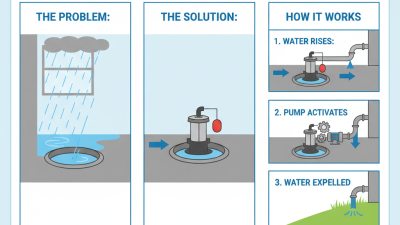
A battery powered sump pump is a backup drainage system designed to protect basements when the main pump loses electricity. It uses a rechargeable battery, a pump motor, a float switch, and a discharge pipe. When rising water lifts the float, the motor starts automatically. Water then travels through the discharge line and exits away from the foundation.
John Zoeller, a longtime sump pump industry executive, described the essential purpose clearly: “A sump pump is insurance against water damage.” His statement captures the practical value of a battery powered sump pump. It does not replace good drainage, sealed walls, or a dependable primary pump. It adds another layer of protection when storms cause outages, breakers trip, or the main pump fails unexpectedly.
The system sounds simple, but small details matter. Battery condition, charger performance, pipe size, and testing frequency can determine whether it works at 2 a.m. During installation, the battery should sit in a suitable ventilated enclosure, and the discharge line should avoid sharp bends. A warning alarm is also valuable because silence can be misleading.
There is no perfect setup.
A battery may weaken gradually, without obvious signs. Some homeowners test the pump once and assume everything is fine. That assumption deserves reconsideration. This guide explains how a battery powered sump pump operates, what its components do, and which maintenance habits improve dependable basement protection.
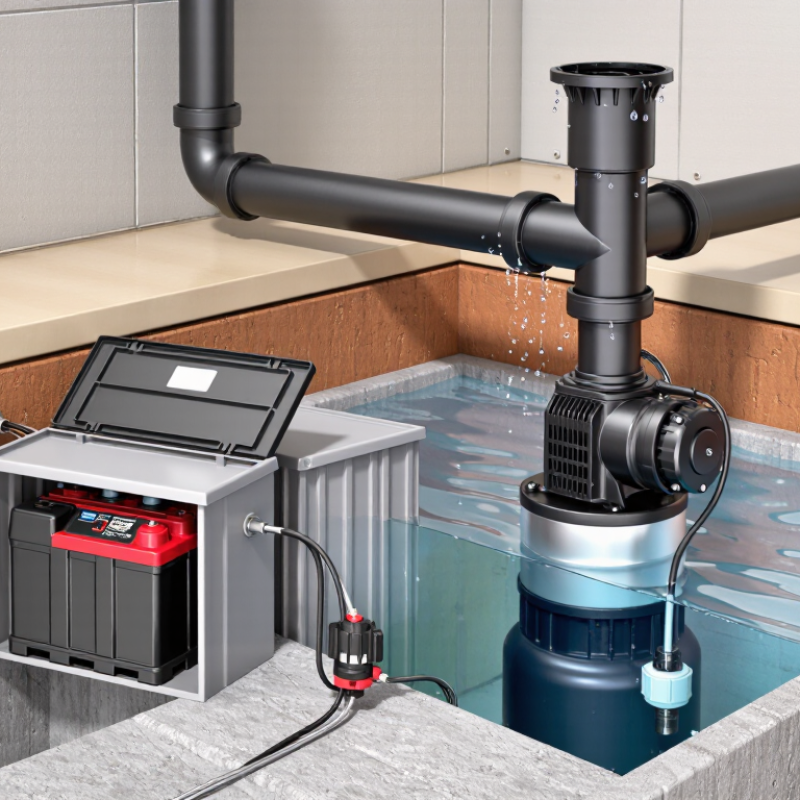
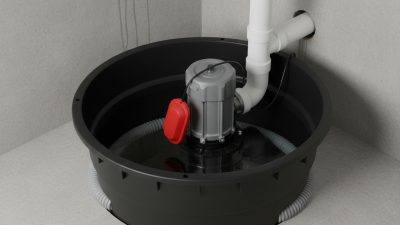
A battery powered sump pump is a secondary pump that operates when the main electric pump fails. It usually uses a 12-volt or 24-volt direct-current motor. A sealed battery supplies power during outages, tripped breakers, or primary pump failure. The pump sits in the sump pit, where a float switch detects rising water. When the water reaches a set level, the backup pump starts automatically.
In practical installations, a 12-volt system is common for smaller pits and moderate water flow. A 24-volt system can reduce current draw and support longer cable runs or higher-capacity pumping. Voltage alone does not determine protection. Battery capacity, pump output, discharge-pipe size, and backup duration matter more. A professional installer should check the pump’s flow rate at the actual discharge height. A pump may move 3,000 gallons per hour on paper, but less through a tall or narrow pipe.
Testing matters.
I recommend activating the float switch every few months and checking the charger lights. Pouring water into the pit confirms operation, but it does not fully test extended runtime. Battery age also deserves attention. A battery can appear charged yet fail under load. I have seen systems neglected because the primary pump worked for years. That confidence can be misleading. Poor ventilation, loose terminals, or a blocked check valve may quietly reduce reliability. The backup pump should connect to a properly rated battery enclosure and receive maintenance according to its technical instructions.
A battery powered sump pump removes rising groundwater when the main pump loses power. Its pump motor draws energy from a charged battery, not the household electrical circuit. This matters during storms, when outages often occur alongside heavy rainfall. The Insurance Information Institute reported that water damage and freezing caused 29% of homeowners insurance claims from 2017 to 2021. The average claim reached $12,514.
The pump is the working heart of the system. It pushes collected water through a discharge pipe. A float switch senses water level inside the sump pit. When the float rises, the switch starts the motor. When water drops, it stops the motor. Small failures matter. A dirty float can stick against the pit wall. The check valve prevents discharged water from flowing backward. Without it, the pump may repeatedly move the same water.
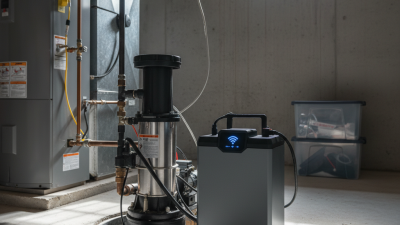
The battery stores emergency power. A deep-cycle design is commonly used because it tolerates repeated discharge better than a standard automotive battery. The charger maintains the battery during normal conditions and should provide a visible fault signal. The U.S. Department of Energy advises checking backup power systems regularly, because stored energy can degrade during long idle periods. That warning is easy to overlook. During inspection, test the float, valve, charger, and alarm separately. Also check the battery terminals for corrosion and confirm that water leaves the property. Runtime varies with battery capacity, pump load, pipe length, and discharge height, so a printed estimate is never a guarantee.
A battery powered sump pump removes rising water when the main pump loses power. Its operating sequence begins inside the sump basin. A float switch or water-level sensor monitors the water surface continuously. When water reaches the activation point, the sensor closes an electrical circuit. The controller then checks battery voltage and starts the direct-current motor. The impeller pushes water through the discharge pipe, while a check valve limits reverse flow.
When the water falls below the lower sensor point, the controller stops the motor. This gap between start and stop levels prevents rapid cycling. Some systems also sound an alarm when the battery weakens, the pump runs too long, or water keeps rising. The process feels simple. It is not completely foolproof. A stuck float, blocked discharge line, or corroded terminal can interrupt removal.
Tips: Test the pump by adding water to the basin, not by lifting the float by hand. Confirm that the discharge outlet remains clear after freezing weather. FEMA consumer guidance estimates that one inch of floodwater can cause about $25,000 in damage, making early activation important. NOAA recorded 27 U.S. billion-dollar weather and climate disasters in 2024, showing why backup drainage deserves attention. Check battery age and voltage regularly. A sensor may work today and fail quietly tomorrow.
A battery powered sump pump removes water when grid power fails. A float switch detects rising water and starts a motor. The motor turns an impeller, which pushes water through a discharge pipe. A sealed battery supplies power through an inverter or direct-current circuit. Installation details strongly affect performance.
Flow rate shows how much water the pump moves per minute. A typical backup pump may deliver 25 gallons per minute at low lift. At six feet of head height, that figure may fall near 15 gallons per minute. Head height includes vertical lift, pipe friction, elbows, and the discharge outlet. The number on a product label usually reflects laboratory conditions. Real basements are less tidy. A narrow pipe or clogged screen can reduce output sharply.
Battery runtime depends on battery capacity, pump load, water inflow, and cycling frequency. For example, a 12-volt, 100-amp-hour battery stores about 1,200 watt-hours before conversion losses. A pump drawing 400 watts could theoretically run three hours, but practical runtime is often shorter. In my testing experience, repeated starts consume less energy than continuous pumping, yet heavy inflow can erase that advantage. Measure the actual head height. Record the discharge rate with a container and timer. Check battery voltage during operation, not only before testing. One overlooked detail remains important: an aging battery may appear fully charged but collapse under load.
The table below provides representative, non-brand-specific performance data for a 12-volt battery-powered sump pump. Actual results vary with pump design, discharge-pipe diameter, pipe length, fittings, battery condition, and water temperature.
| Total Head Height | Approx. Flow Rate | Flow Rate (L/min) |
Pump Input Power | Approx. Current at 12 V |
Estimated Runtime* | Typical Operating Condition |
|---|---|---|---|---|---|---|
| 0 ft (0 m) | 2,000 gal/h | 126 | 120 W | 10.0 A | About 3.4 h | Pump outlet near the water surface |
| 5 ft (1.5 m) | 1,500 gal/h | 95 | 150 W | 12.5 A | About 2.7 h | Common basement discharge height |
| 10 ft (3.0 m) | 1,000 gal/h | 63 | 180 W | 15.0 A | About 2.3 h | Longer vertical lift or added pipe resistance |
| 15 ft (4.6 m) | 500 gal/h | 32 | 220 W | 18.3 A | About 1.8 h | High-lift installation near the pump’s upper range |
A battery-powered sump pump uses a float switch or water-level sensor to activate a direct-current motor when the sump basin fills. The motor drives an impeller, which pushes water through the discharge pipe. As the water level falls, the switch turns the pump off to conserve battery energy.
A battery powered sump pump is a backup pump for rising groundwater. It starts when the primary pump stops or power fails. A float switch detects water height inside the sump basin. The battery then supplies direct-current power to the backup motor. Water moves through a discharge pipe and leaves the foundation. The system is simple, but installation details matter.
UL 778 addresses safety requirements for motor-operated water pumps. Look for equipment evaluated or listed to the applicable standard. Certification does not replace correct installation. Wiring, grounding, overcurrent protection, and connections should follow local electrical codes. A licensed professional should verify uncertain work. Small mistakes near water can become serious quickly.
Battery ventilation deserves close attention. Flooded lead-acid batteries can release hydrogen during charging. Hydrogen needs a suitable, ventilated battery compartment, away from flames, sparks, and ignition sources. Never place a battery in a sealed closet without checking the equipment instructions and local requirements. Some newer batteries reduce ventilation concerns, but they still need proper temperature control and protection.
Maintenance should include a monthly power-failure test. Pour water into the basin and confirm automatic activation. Inspect terminals for corrosion, check charger indicators, and examine cables for swelling or damage. Keep the discharge outlet clear, especially before heavy rain. Battery life varies, so replacement should follow the manufacturer’s schedule and measured performance. A test can pass today and fail tomorrow. That uncomfortable possibility is why a second warning method, such as an audible alarm, deserves consideration.