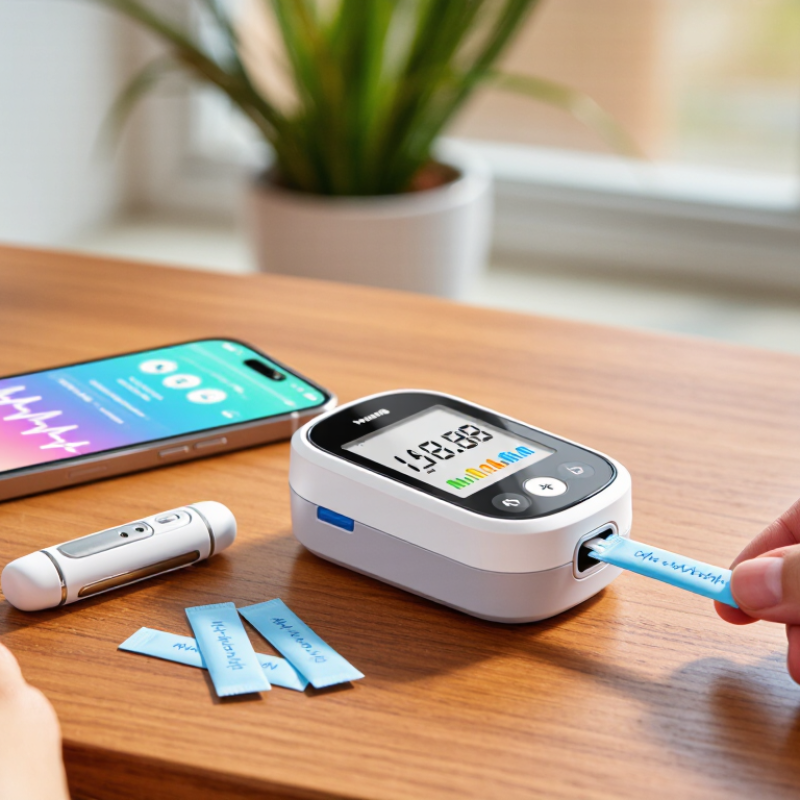
| Measurement Accuracy | Accurate readings support safer treatment decisions and reduce the risk of reacting to measurement error. | Look for independently documented performance against ISO 15197:2013 requirements: at least 95% of results within ±15 mg/dL below 100 mg/dL, or within ±15% at 100 mg/dL and above. | Review the complete accuracy study, sample size, glucose range, user testing conditions, and whether results were independently evaluated. | Essential |
| Blood Sample Size | A smaller sample can make testing easier, especially for people with sensitive fingers, limited dexterity, or frequent testing needs. | A sample requirement of about 1 µL or less is a useful convenience benchmark, provided accuracy is not compromised. | Confirm the exact sample volume, alternate-site testing rules, and whether an insufficient sample can be detected before a result is displayed. | Essential |
| Test-Strip Handling | Strip storage and expiration can affect performance and create avoidable costs or inaccurate results. | Prefer individually wrapped strips or packaging with clear moisture protection, a visible expiration date, and a long remaining shelf life. | Check the open-vial stability period, storage temperature range, humidity instructions, strip availability, and cost per test. | Essential |
| Automatic Bluetooth Sync | Automatic transfer reduces manual logging and helps preserve a consistent record of readings, times, and events. | Choose a meter that supports reliable Bluetooth Low Energy synchronization with the current operating systems used by the intended user. | Check pairing steps, reconnection behavior, supported phone versions, offline storage capacity, and whether readings sync without opening the app. | Essential |
| Data Export and Sharing | Portable records make it easier to discuss trends with clinicians and avoid being locked into one application. | Prefer export in a common format such as CSV or PDF, with date, time, glucose value, unit, meal tag, and notes included. | Verify whether data can be exported without a subscription and whether reports can be shared securely with a healthcare professional. | Essential |
| Measurement Units | Different regions use different glucose units, and an incorrect unit can cause serious interpretation errors. | The meter and app should clearly support the unit required in the user’s region: mg/dL or mmol/L. | Confirm whether the unit can be changed, whether the app uses the same unit, and whether exported reports label the unit clearly. | Essential |
| Event and Meal Tagging | Tags help distinguish fasting, pre-meal, post-meal, exercise, medication, and illness-related readings. | Look for customizable notes and at least basic pre-meal, post-meal, fasting, exercise, and medication tags. | Check whether tags are available on the meter itself, stored with the reading, searchable, and included in exported reports. | Important |
| Trend Analysis | Patterns over several days or weeks are usually more useful than isolated readings. | Useful dashboards include daily averages, time-of-day patterns, target-range summaries, and selectable date ranges. | Confirm that graphs show the actual readings, timestamps, tags, and missing data rather than only simplified averages. | Important |
| High and Low Alerts | Alerts can draw attention to readings outside personal targets, but they should support—not replace—clinical advice. | Prefer configurable thresholds, repeat reminders, and clear distinction between a reading alert and a technical error. | Check whether alerts work on the meter, phone, or both; whether they function offline; and whether thresholds can be set safely. | Important |
| App Privacy and Security | Glucose records are sensitive health information and may include dates, locations, notes, and account details. | Look for encryption in transit and at rest, two-factor authentication, clear consent controls, and a transparent privacy policy. | Review data retention, deletion requests, third-party sharing, account recovery, advertising practices, and whether cloud sync is optional. | Essential |
| Cloud Dependence | A meter should remain usable when a phone, internet connection, or service account is unavailable. | The device should store readings locally and allow basic testing without an active internet connection or paid membership. | Confirm local memory capacity, what happens when memory is full, and whether historical data can be retrieved after a phone change. | Essential |
| Display and Accessibility | Readable results reduce user error, particularly for people with visual, motor, or cognitive limitations. | Prefer high-contrast digits, backlighting, simple navigation, tactile buttons where appropriate, and readable error messages. | Test the display in bright and low light, check font size, confirm audio or accessibility support, and assess strip insertion difficulty. | Essential |
| Power and Battery Life | Unexpected battery failure can interrupt testing and prevent wireless synchronization. | Choose a device with a commonly available battery or dependable rechargeable power, plus a clear low-battery warning. | Check expected test count per battery, charging connector, travel behavior, battery replacement requirements, and whether testing works while offline. | Important |
| Time and Date Reliability | Accurate timestamps are necessary for identifying fasting, post-meal, overnight, and medication-related patterns. | The meter should retain time and date during battery changes and handle daylight-saving or time-zone changes predictably. | Verify automatic time synchronization, manual correction options, and how corrected timestamps appear in reports. | Important |
| Control Testing and Quality Checks | Control solutions help confirm that the meter and strips are functioning as expected under specified conditions. | Choose a system with clearly documented control-test procedures and separately identifiable control results. | Check control-solution availability, recommended testing situations, storage instructions, and whether the app distinguishes control tests from blood tests. | Important |
| Regulatory Status and Documentation | Regulatory clearance or approval and complete instructions provide a baseline of safety and intended-use information. | Buy only a meter legally marketed for the intended use and region, with accessible instructions and performance information. | Verify the applicable regulatory listing, intended patient population, warnings, limitations, and instructions for use. | Essential |
| Total Cost of Ownership | The ongoing cost of strips usually matters more than the initial meter price because strips are the recurring expense. | Compare the estimated annual cost using the user’s actual testing frequency, including strips, lancets, control solution, batteries, and subscriptions. | Check local reimbursement, strip availability, subscription requirements, refill prices, and whether premium app features are optional. | Essential |
| Support and Replacement Process | Technical help is important when readings, synchronization, or strip performance becomes unreliable. | Prefer documented support channels, clear warranty terms, troubleshooting guides, and a defined replacement process. | Check support hours, response options, warranty duration, regional service coverage, and how data are preserved after device replacement. | Important |